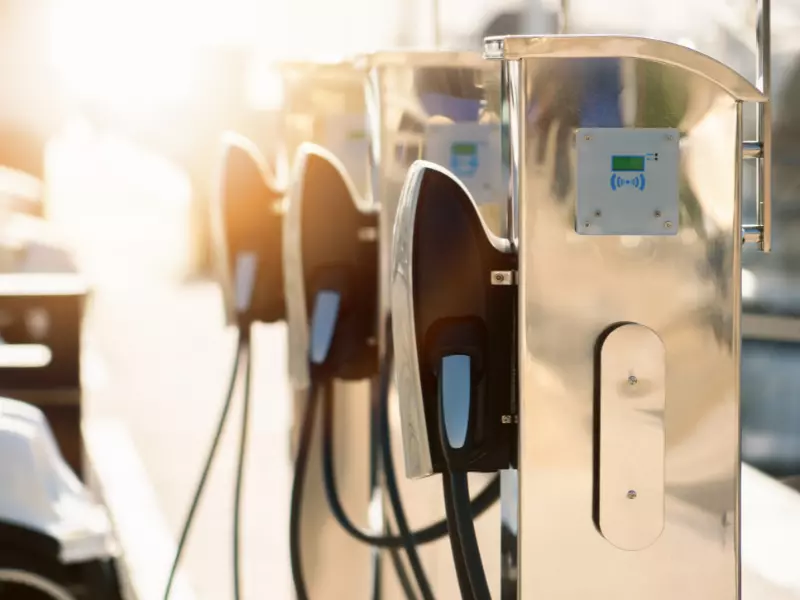
How and where it is more profitable to charge an electric car in Ukraine

With the growing demand for electric cars in the world in general, and in Kyiv and Ukraine in particular, the issue of their charging has become more urgent. The infrastructure of recharging points is starting to develop, so most users are faced with the question: where to charge an electric car, at home or at a public charging station?

In terms of time, it is almost the same (5-9 hours or more, depending on the maximum throughput), but how profitable it is – we calculated for each case separately.

Where can you charge an electric car and how much will it cost?

Charging points are located at gas stations, parking lots, near cafes or shopping centers. Before choosing, you need to know the type of charging cable connector.

There are six of them in total:

  • Wall Outlet (Euro Plug);
  • Mennekes (Type 2);
  • EV Plug (J1772);
  • Three Phase 32A;
  • Wall Outlet 120v;
  • Tesla HPWC (Model S).


Let’s say that in the same Kyiv there are many places for free “recharging”, but they all have a common set of difficulties:

  1. Big queue;
  2. Long waiting time;
  3. The connector is not always suitable;
  4. The cable can be stolen;
  5. You will have to pay for parking.

Popular free places in Kyiv:

  1. Gulliver shopping center underground parking, you need to pay for parking;
  2. Business center “101 Tower”, you need to pay for parking;
  3. Underground parking of the Hilton hotel, you need to pay for parking (there is an hourly or daily rate);
  4. IQ Business Center, must pay for parking, lowest rate at night.


Network charging stations usually require prepayment. Each company has its own tariffs, for example:

  1. “TOKA” network – for use, it is necessary to make a prepayment of UAH 1,000 to UAH 3,000, while the tariff is UAH 0.73 to UAH 0.84 for the equivalent of 1 km of Nissan Leaf mileage. (available only in Kyiv, Odesa and Lviv);
  2. Autoenterprise – tariffs: 10 kW – 1 UAH/min, CHAdeMO (fast charging) 20 kW – 2 UAH/min, CHAdeMO 40 kW – 4 UAH/min, about 1,000 electric filling stations throughout Ukraine;
  3. Octane – 4 hryvnias/kWh, charging stations are available only in Kyiv;
  4. WOG – you can charge for free, but for a long time. More than 300 points throughout Ukraine.


To see the entire map of charging stations in Ukraine, you can download a special application for the relationship, for example, PlugShare, to your smartphone.

Be that as it may, it is easiest and cheapest to charge an electric car at home. You will definitely not face the problem of a queue, malfunction or lack of the necessary cable, and you will have to pay according to the cost of electricity, which is many times cheaper than overpaying for forced parking. By leaving the car to charge overnight in the garage, you can rest assured that nothing will happen to it, and in the morning it will stand with a “full tank”.

A charging station at home is efficient, fast, safe, but not everything is so straightforward

The use of a charging station at the household level is a more effective saving of electricity due to its high efficiency. All car manufacturers recommend charging through it.

The main advantages of home security:

  1. Faster and more efficient charging due to conversion of current parameters;
  2. Preservation of the battery resource during long-term operation;
  3. Monitors the state of the connected power grid, protection against overloads.


The only disadvantage of home military equipment is their cost. For example, the price of a 3.7 kW household model starts at EUR 750, and a more powerful 7.2 kW model starts at EUR 900. In the Ukrainian reality, the purchase of household appliances for such a price is justified only for shared use – in closed parking lots or near a business center.

Charging from an outlet - is it possible or not?

For home recharging, you need to install a special three-phase 380V socket, which will charge three times faster than the usual 220V. A cable with a “charger” is connected to it.

Some manufacturers produce special chargers for a regular 16A 220V socket, but this will be a very long process, so such devices are sold or included in the kit as additional ones.

Charging from an outlet – it is advisable to use it exclusively as a backup option in case there is no other option. It is not recommended to do this regularly because the cable overheats, and the battery itself receives a current of suboptimal parameters, which reduces its resource.

Some electric cars only charge when there is a ground connection. For example, the “smart” cable Mobile Connector for Tesla Model S tests the network for the presence of ground when connected. Charging will not start until the device sees it.

There are special chargers that do not require grounding, but their use is not recommended due to the increased load on the network.

In the household network, the voltage is 220V and the current is up to 16A. Under ideal conditions, you can receive electricity up to:

220V × 16A = 3520 W (3.52 kW).

In fact, this is an average value of 2.5 to 3 kW, due to the fact that over time the contacts deteriorate, and even the wiring wears out. In order to receive the declared current of 16A, it is better to conduct new wiring and install high-quality sockets, for example, from Legrand.

Nissan Leaf 2015, popular in Ukraine, is equipped with a 24 kWh battery. To fully charge it from the home network, you need approximately time:

24 kWh / 2.5 kW = 9 hours 40 minutes.

In fact, more, since the process is not linear in power and time, after 80% – it is slow, and during the conversion, about 10% of electricity is lost.

If you have an 85 kWh Tesla Model S, you will have to wait even longer:

85 kWh/ 2.5 kW = 34 hours

If you install a three-phase 16A outlet, you can charge much faster. Without taking into account losses, its maximum throughput will reach:

380V × 16A × 1.72 (cos φ) = 10458 W (10.46 kW).

Accordingly, a full charge from a three-phase network will not take longer:

24 kWh / 10.46 kW = 2 hours 20 minutes for a Nissan Leaf
85 kWh/10.46 kW = just over 8 hours for the Tesla Model S

In a linear connection, the loss of electricity during conversion reaches 10% (in some – 2-3%).

In Ukraine, there are REM restrictions regarding the maximum permissible load on the consumer, as a rule, for a private house, it is 5 – 10 kW, depending on the capabilities of main branches. If desired, the load can be increased, but this is a separate financial issue.

If you charge through a station, with 5 kW of output power, the same Nissan Leaf will be charged in 5-6 hours. If the manufacturer is to be believed, the maximum range at full capacity is 150 km (in fact, on average, about 100 km) – 24 kWh/100 km.

If everything is clear with the charging speed, then we will deal with financial costs.
The cost of electricity costs

And yes, on average, the daily mileage of a car in the city on business is 100 km (conventional figure). For ease of calculation, let’s take this indicator and compare what the consumption will be in the 2015 Nissan Leaf and the similar Nissan Juke in the basic configuration of 2017 with an internal combustion engine.

To cover a distance of 100 km on a Nissan Leaf, full capacity (24 kWh) is required. As a result, with a full daily charge, in a month you will use electricity:

24 kWh × 30d = 720 kWh.

With a tariff for electricity in Ukraine of 1.68 UAH/kWh, a month of driving will cost you:

UAH 1.68 / kWh × 720 kWh = UAH 1210.

For comparison, fuel consumption in the Nissan Juke in the city cycle is 7.6 l/100 km. Monthly fuel consumption will be:

7.6 l × 30 d = 228 l.

At the average price of A-95 in Ukraine of UAH 50/l, you will spend monthly on refueling:

228 l × 50 hryvnias/l = 11,400 hryvnias.

Another confirmation that even with single-tariff accounting, driving an electric car is clearly more profitable than an analogue with an internal combustion engine, and this is not counting the absence of costs for replacing filters and oil.

It is best to take care of charging arrangements before purchasing an electric car. In any case, before buying, you should know exactly where you will charge it.

Articles

Logistar

Заповніть, будь ласка, Ваші дані, і ми зв'яжемося якнайшвидше.

В роботі кожного дня!

Logistar

Please fill in your details and we will contact you as soon as possible.

Ready to work, day in and day out!